REAL ESTATE INSIGHTS | INVESTMENT OUTLOOK
The Future of Real Estate Investment in Chandigarh Tricity: What the Next Five Years Could Look Like (2026–2031) test 1
An independent, research-based outlook on Chandigarh Tricity's property market, infrastructure developments and investment opportunities over the next five years.
19 November 2026 · RV Realtors
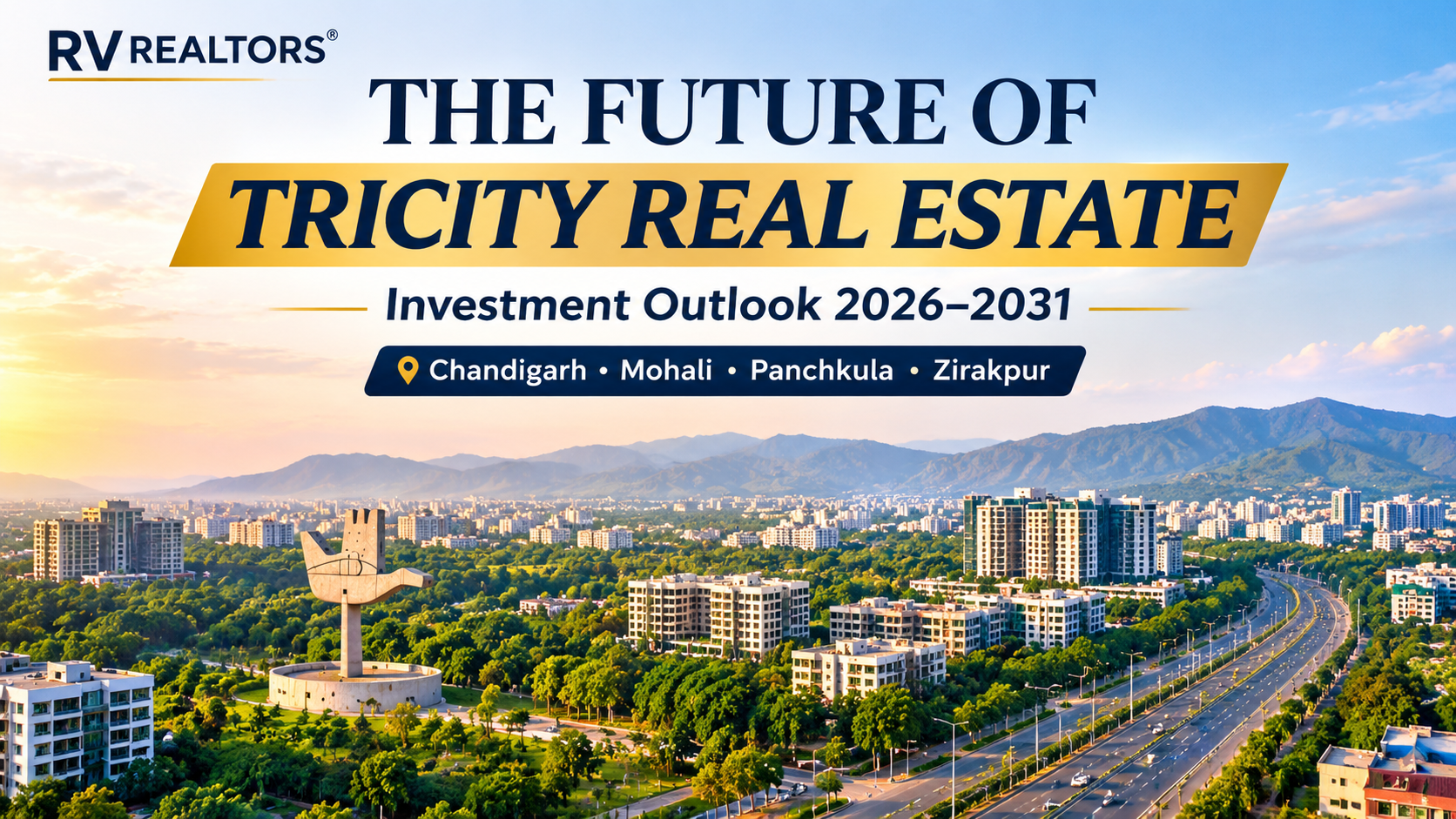
Introduction: Is Chandigarh Tricity entering a new phase of real estate growth? Real estate investment is changing. Buyers are increasingly looking beyond a property's location and asking more important questions: Where will employment grow? Which areas will receive better infrastructure? Where will people want to live? Which locations can generate rental income? And, most importantly, will the property retain its value over time? These questions make Chandigarh Tricity an interesting region to study over the next five years. The Tricity region, comprising Chandigarh, Mohali and Panchkula, has gradually evolved into a larger urban and economic ecosystem. Its surrounding markets, including Zirakpur, New Chandigarh, Kharar and the airport-side development belt, are becoming increasingly relevant to residential and commercial property decisions. However, the investment opportunity should not be confused with a guaranteed price increase. The next five years could bring opportunities through infrastructure expansion, commercial development, improved connectivity and changing residential preferences. The actual outcome will depend on execution, affordability, employment creation, regulatory compliance and the quality of individual projects. This article examines those factors using government publications and publicly available institutional data, without relying on developer-sponsored forecasts or paid promotional property reports. 1. Why the Tricity region deserves attention One of the region's biggest strengths is that its real estate demand is not dependent on a single industry. Chandigarh functions as an administrative, educational, healthcare and professional-services centre. Mohali has developed a broader commercial and institutional ecosystem, while Panchkula offers an established residential environment with access to Chandigarh. Zirakpur, meanwhile, serves as an important residential and connectivity-oriented market for people who want access to Chandigarh, Panchkula and Mohali. This interconnected structure creates several types of housing demand: Professionals working in the region. Business owners and entrepreneurs. Students and educational-sector employees. Healthcare professionals and patients' families. Families relocating from other parts of Punjab, Haryana and neighbouring states. Investors looking for rental income or long-term capital preservation. The important distinction is that these groups do not necessarily demand the same kind of property. A location suitable for luxury residential investment may not be suitable for affordable rental housing or commercial investment. That is why understanding individual micro-markets will become more important than simply investing in the Tricity name. 2. Infrastructure: One of the biggest factors shaping the next five years Infrastructure can influence real estate demand, but the difference between an announced project and a completed project is crucial. Mohali's expansion around the airport and IT City Mohali's airport-side development corridor is one of the areas worth watching. The Greater Mohali Area Development Authority (GMADA), in its 40th Authority Meeting held on 18 February 2026, approved the proposal for land acquisition for the development of Expo City near the airport and IT City in SAS Nagar. The same meeting also considered the development of a commercial city centre in New Chandigarh. These decisions indicate that the region's development planning is not limited to residential housing. Commercial, institutional and supporting urban uses are also part of the broader growth direction. For investors, this raises an important question: Will future commercial activity create sustainable demand for nearby residential properties, offices, retail spaces and rental accommodation? That relationship is worth monitoring over the coming years. Investment perspective: Locations with genuine access to employment, established roads, public utilities and operational commercial facilities may have stronger long-term fundamentals than locations relying primarily on future development announcements. The airport's growing regional importance The Shaheed Bhagat Singh International Airport is another important regional asset. Airports Authority of India (AAI) data records approximately 4.15 million passenger movements at Chandigarh Airport in FY 2024–25, compared with approximately 3.68 million in FY 2023–24. This represents growth in passenger activity, although passenger traffic alone does not establish future property appreciation. The airport can support demand for hospitality, serviced accommodation, business travel-related services and commercial activity. Its actual influence on surrounding property markets will depend on connectivity, business expansion and the development of supporting infrastructure. Investment perspective: Airport accessibility is a factor worth considering, but investors should assess actual travel times, road connectivity, noise exposure, land-use restrictions and the surrounding area's development status before purchasing. What about the proposed Tricity Metro? Public transport is another major long-term consideration. GMADA's published infrastructure information describes a proposed Tricity Metro network connecting Chandigarh, Mohali and Panchkula, including corridors towards New Chandigarh and Sector 70, Mohali. However, a proposal or planning document should not be interpreted as confirmation of a completed, funded or operational metro system. In its response to Rajya Sabha Unstarred Question No. 1041, answered on 9 February 2026, the Ministry of Housing and Urban Affairs also explained that urban planning responsibilities lie primarily with the relevant urban local bodies and development authorities. This highlights an important reality: coordinated regional infrastructure requires administrative cooperation between different jurisdictions. Investment perspective: Do not pay a premium today solely because a property is advertised as being near a future metro station. Verify the officially approved alignment, station location, implementation status and expected accessibility. 3. Five locations and their possible investment positioning The Tricity should not be viewed as one uniform property market. Different locations have different strengths, risks and investment profiles. A. Mohali: The commercial and institutional growth opportunity Mohali has a strong case for investors interested in the relationship between residential and commercial development. Its airport-side corridor, IT City, institutional establishments and planned commercial development provide several potential demand drivers. The most interesting opportunities may emerge in locations where employment, residential occupancy and supporting retail infrastructure grow together. Potential investment categories: Residential properties near established employment centres. Commercial units in functioning business locations. Well-connected residential plots in approved developments. Rental properties serving working professionals. What to watch: Actual commercial occupancy, road completion, civic infrastructure, project approvals and the availability of employment opportunities. B. Zirakpur: Connectivity and residential demand Zirakpur has an important geographical advantage: it connects several parts of the Tricity and provides access to Chandigarh, Panchkula, Mohali and major regional road networks. Its residential market offers a variety of apartments, independent floors and other housing formats. The next five years could favour properties that solve practical residential problems rather than merely offering attractive launch prices. Buyers are likely to pay attention to: Reliable water supply. Sewerage and drainage. Traffic management. Parking availability. Building maintenance. School and healthcare accessibility. Daily commuting convenience. For investors, the quality of the society and its actual occupancy can matter more than the advertised amenities. Investment perspective: Established, well-maintained and legally compliant residential communities deserve closer examination, especially where genuine end-user demand exists. C. New Chandigarh: A longer-term development proposition New Chandigarh represents a different kind of opportunity. Its development is associated with planned urban expansion rather than simply the extension of an existing residential neighbourhood. GMADA publishes a New Chandigarh development plan covering the 2008–2031 planning horizon. Its February 2026 Authority Meeting also approved the acquisition proposal for a commercial city centre in the area. These are meaningful planning signals, but they should not be mistaken for proof that every proposed sector or commercial development is already operational. New Chandigarh may appeal to buyers with a longer investment horizon who are comfortable evaluating development-stage locations. Potential categories include: Approved residential plots. Residential properties in established projects. Commercial property in viable locations. Housing suited to future institutional and professional demand. Investment perspective: The distance between a proposed development and actual everyday infrastructure should be a major part of the purchase decision. D. Panchkula: Established residential appeal Panchkula has an established residential identity, planned sectors and access to Chandigarh. The Haryana Government announced a development allocation of approximately ₹829.23 crore through the Panchkula Metropolitan Development Authority for FY 2026–27. According to the government's September 2026 release, this includes infrastructure, operations and maintenance, and urban-environment-related expenditure. The announced works cover areas such as drainage, sewerage, roads and green spaces. For investors, Panchkula may be worth considering where established residential demand, civic infrastructure and long-term livability are the main priorities. Investment perspective: The appeal here is not necessarily rapid speculative growth. Established neighbourhood quality, limited supply in desirable pockets and end-user demand can be equally important. E. Kharar and the wider Mohali extension Kharar is another market to monitor because of its relationship with Mohali and the wider Chandigarh region. Its affordability relative to some premium locations may attract first-time buyers, families and people seeking larger residential options. However, investors should be particularly careful about: Unauthorised colonies. Unclear land titles. Incomplete infrastructure. Excessive future supply. Long commuting distances. Weak resale liquidity. A lower purchase price does not automatically mean better investment value. 4. What could drive property demand between 2026 and 2031? We believe five factors deserve particular attention. 1. Employment and business expansion Long-term residential demand becomes more sustainable when people have reasons to work and live in a region. Commercial development, IT-related activity, institutional expansion and supporting services could strengthen this relationship. Investors should follow actual job creation and business occupancy rather than relying on proposed commercial projects alone. 2. Improved regional connectivity Better roads, junctions, public transport and airport access can improve the attractiveness of certain locations. However, infrastructure benefits are rarely distributed equally. Properties with practical access to completed infrastructure may be better positioned than properties that are merely close to a proposed project. 3. Changing housing preferences Modern buyers increasingly evaluate security, parking, maintenance, open spaces, reliable utilities and access to everyday services. Developments that offer a functional living environment may retain stronger end-user appeal. 4. Rental housing demand The presence of educational institutions, hospitals, businesses and employment centres creates potential rental demand. But rental income must be calculated realistically. Investors should compare annual rent against the total acquisition cost, including registration, furnishing, maintenance, vacancy and other expenses. 5. Regulatory transparency As buyers become more informed, documentation and legal compliance should become increasingly important differentiators. RERA registration, approved building plans, land ownership, completion certificates and possession conditions deserve careful examination. 5. Which property investment strategy may make sense? There is no single strategy suitable for every investor.
Investor profile Property category to evaluate Main consideration Long-term investor Approved residential plots Development and holding horizon Rental-income investor Ready-to-occupy apartments Actual achievable rent Business investor Commercial property Occupancy and tenant demand Family buyer stablished residential societies Livability and accessibility Higher-risk investor Emerging development corridors Legal status and execution risk
An investor should calculate the total cost of ownership instead of comparing only the advertised price per square foot. For rental investments, a simple starting calculation is: Gross rental yield = Annual rental income ÷ Total property acquisition cost × 100 For example, if a property costs ₹60 lakh in total and generates ₹18,000 in monthly rent: Annual rental income = ₹2,16,000 Gross rental yield = 3.6% per year. This is before maintenance, vacancy, taxes, repairs and other costs. It demonstrates why investors should evaluate rental income and capital appreciation as separate parts of an investment decision. 6. The risks investors should not ignore A credible investment outlook must discuss risks as openly as opportunities. The next five years could also bring challenges: Oversupply: Excessive residential or commercial construction in particular micro-markets could limit rental growth and resale demand. Infrastructure delays: Announced roads, public transport and commercial developments may take longer than expected. Legal complications: Unapproved colonies, incomplete permissions and disputed land titles can create substantial financial and legal problems. Affordability pressure: If property prices rise faster than local incomes and rents, genuine buyer demand may weaken. Liquidity risk: A property may look valuable on paper but still take months to sell at the desired price. Environmental and civic issues: Drainage, groundwater, water supply, pollution and traffic conditions can materially affect a property's long-term attractiveness. Investors should also distinguish between registered property transactions and advertised asking prices. Asking prices do not necessarily represent actual market-clearing values. 7. Our outlook for the Tricity real estate market: 2026–2031 Our assessment is that the Tricity region offers several interesting investment themes, but its future is likely to be uneven. Mohali's airport-side and commercial development corridors deserve attention because of their institutional and infrastructure-related growth potential. Zirakpur's appeal is linked to residential accessibility, established occupancy and the ability of local infrastructure to support continued urban growth. New Chandigarh represents a longer-horizon planning and development opportunity, while Panchkula continues to offer an established residential proposition. Chandigarh itself remains an important anchor for the wider region. We do not believe that every locality will experience the same appreciation, nor is it responsible to promise a particular percentage of price growth without reliable transaction-level evidence. The stronger investment opportunities are likely to be found by examining individual sectors, projects, legal documentation, infrastructure delivery, actual occupancy and resale activity. Three investment principles for the next five years Buy verified development, not just future promises. Give greater weight to completed infrastructure and legally approved projects. Prioritise genuine demand. Look for employment, residents, tenants and functioning commercial activity. Protect your downside. Assess legal title, liquidity, total acquisition cost and the possibility of delayed development before investing. Conclusion: The future belongs to informed investors The next five years could be an important period for the Chandigarh Tricity real estate ecosystem. The combination of Mohali's commercial expansion, airport connectivity, New Chandigarh's planned development, Panchkula's urban infrastructure and Zirakpur's residential positioning creates multiple investment possibilities. But the biggest opportunity may not be buying the most expensive property or chasing the next advertised growth corridor. It may be identifying a legally sound property in a location where real people want to live, work and do business. At RV Realtors, we believe informed decisions should begin with verified information, realistic expectations and an understanding of the local market. The future of real estate is not just about where a city expands. It is about where sustainable demand develops. --- About RV Realtors RV Realtors is a real estate platform focused on helping buyers, sellers and investors explore property opportunities across Chandigarh Tricity and surrounding markets. Our approach is built around informed property decisions, location understanding and transparent information. Explore properties and discover more at: https://rvrealtors.com/ Disclaimer: This article is an independent editorial analysis prepared using publicly available government and institutional information. It is not a guarantee of future property prices, returns, rental yields or investment performance. Development proposals and government allocations are subject to approvals, implementation and change. Readers should independently verify project approvals, title documents, RERA registration, local regulations and market transactions before making an investment decision.